
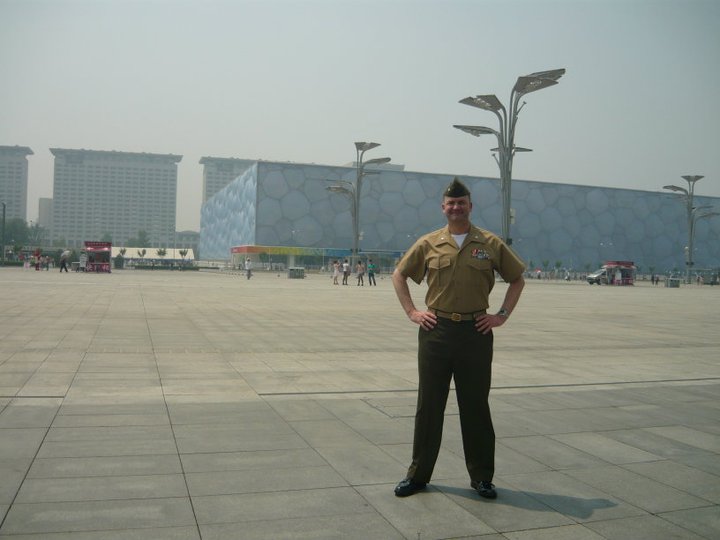
There is a particular kind of knowledge that accumulates slowly, over decades, without any clear plan for where it is going. You study a language because the military sends you to study it. You earn a graduate degree in Asian Studies for the same reason. You spend years in East Asia — observing, reading, absorbing — and you file it all away. Eventually, if you are lucky, the filing cabinet gets full enough that something has to come out of it.
That, in the simplest terms, is how The Dragon Gate Conspiracy came to be written.
I spent more than two decades as a United States Marine Corps officer. My undergraduate degree from Virginia Military Institute was in English — one of the “artier” majors at VMI, but the Marine Corps is surprisingly tolerant about what its prospective officers study. It turned out to be exactly the right foundation for a second career I didn’t know I was preparing for.
Later, at the Naval Postgraduate School in Monterey, I completed a Master’s degree in Asian Studies. Add several years of language and defense studies training in Japan, and extensive travel in the region, and you end up with a fairly specific set of intellectual tools that often sat in the drawer before I found the right use for them.
The question, once I left active duty, was what to do with it all.
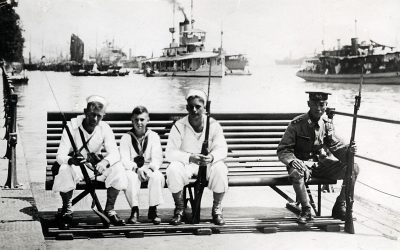
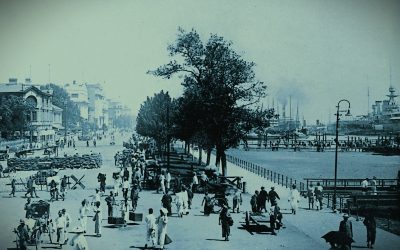
I had been drawn to the history of the Western presence in East Asia since 1992 and my first tour in Okinawa. Having grown up in Europe, it was a whole new world. Over time, I grew fascinated by the treaty ports, the foreign concessions, the gunboats on the Yangtze, the extraordinary cast of characters who ended up in places like Shanghai and Hankow during the first half of the twentieth century. It is a period that most Western readers know almost nothing about, which made it both a challenge and an opportunity. If you set a novel in World War II France or Cold War Berlin, your readers arrive with a mental map already drawn. Set it in Warlord-Era China, and you are drawing the map from scratch.
I decided that was a feature, not a bug.
The Dragon Gate Conspiracy is set in Hankow, present-day Wuhan, during the summer and early autumn of 1926. The city was then a patchwork of foreign concessions carved out of the Chinese interior by imperial powers: British, French, Japanese, Russian, German, and American. The KMT’s National Revolutionary Army, led by General Chiang Kai-shek and backed by Soviet advisors, was driving northward in what history calls the Northern Expedition. The warlord General Wu P’ei-fu was defending the city. The whole arrangement was about to come apart.
Into this world I placed a young U.S. Marine Corps lieutenant named Jack Gaines. He’s a Virginian, a professional, caught between the demands of his duty, an unexpected love affair with an American journalist, and a conspiracy that reaches further than he can initially see. Jack is, in some respects, a vessel for the things I know: what it feels like to be a junior officer responsible for men in an uncertain environment; how foreign cities look and smell and sound; the particular quality of attention you develop when events around you are accelerating and you cannot quite see where they are heading.
That is not autobiography. Jack Gaines is a fictional character, and his story is a novel. But the texture of his world — the culture, the political landscape, the physical city — is drawn from a long study of the historical record, and I like to think that shows in the writing.
The other thing I had, which no amount of research can fully substitute for, was direct experience of the region. Japan is not China, and the 2000s are not the 1920s, but years in East Asia leave traces that show up in unexpected places — the heat of a Shanghai summer afternoon, the sounds and smells of a night market, the peculiar expat experience of being immersed in a world that is not quite your own. Those details are harder to get from books.
The Dragon Gate Conspiracy is my first novel. It will not be my last. There is more of this world to explore, and I intend to explore it. I hope you will come with me!
— J. R. Kendall
0 Comments