
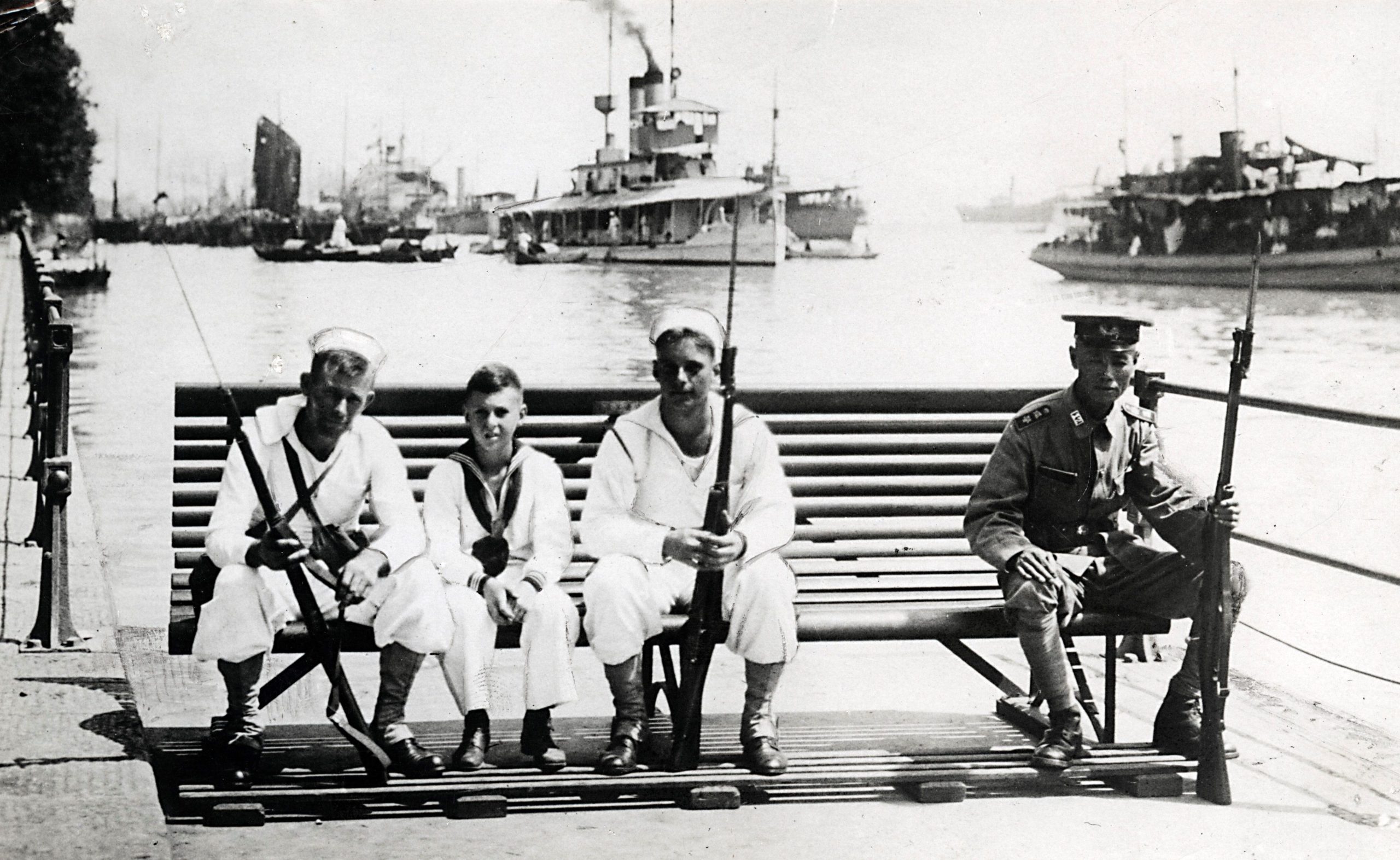
If you have read The Dragon Gate Conspiracy, you have already met a few of them: the laconic, sun-bronzed Sailors aboard the USS Patuxent. The book opens with Jack Gaines watching them banter in pidgin with Chinese hawkers from the rail as the gunboat noses upriver toward Hankow. Some of the Sailors, Jack Gaines notices, have grown the informal beards that mark a man who has been on the river a while. These are the River Rats, and their story is worth telling.
The Mission
The U.S. Navy’s Yangtze River Patrol, or “YangPat,” traced its formal origins to 1903, in the aftermath of the Boxer Uprising. (However, American warships had plied the river since the aftermath of an incident in 1854). By the 1920s, China’s central government had effectively ceased to function as a reliable guarantor of foreign lives and commerce. The foreign powers, Britain, France, Japan, the United States, and others, each maintained river flotillas to protect their nationals and keep the trade routes open.
For the Americans, this meant a succession of small, shallow-draft gunboats operating on one of the world’s great rivers. The Yangtze runs nearly 4,000 miles from the Tibetan plateau to the sea, and its middle and upper reaches, beyond Shanghai and Nanking, were unsettled country: warlord armies, river pirates, and treacherous gorges where the river narrowed to a thundering canyon. The YangPat’s gunboats had to be capable of operating anywhere on that river, under any political conditions. The patrol fell under the Asiatic Fleet, headquartered in the Philippines, and it operated in constant, usually cordial, proximity to the British, French, Japanese, and Italian river squadrons doing the same work.
The Ships
The YangPat’s river contingent in the mid-1920s was a varied collection of vessels reflecting decades of improvisation. USS Palos and USS Monocacy were the most modern: purpose-built river gunboats designed in the United States and constructed in Shanghai after the First World War, engineered specifically for the Yangtze’s demands. The Patuxent of my novel is modeled on this pair. USS Elcano was a veteran of the Spanish-American War, a captured Spanish gunboat that had somehow outlasted the century. USS Pigeon, a repurposed minesweeper, completed the force around Hankow during the time of the book. Displacing only a few hundred tons and drawing just a few feet of water, these were functional vessels, not impressive ones.
The River Rats
For a Navy enlisted man, the China Station was widely regarded as one of the best assignments the service offered, and the YangPat was the best of the China Station. Each gunboat carried a Chinese shadow crew, local men contracted to handle cooking, laundry, cleaning, and routine maintenance. An American Sailor on the Yangtze lived, by comparative naval standards, rather well.
The liberty opportunities in Hankow, Shanghai, and the other treaty ports were legendary, and the men made the most of them. American Sailors were considered well paid by the standards of the treaty ports, where the U.S. dollar fetched roughly two Mexican silver dollars, or “Mex,” the currency in common circulation across the treaty ports, and a River Rat with a few days’ liberty ashore had both the means and the motivation to spend freely. An old saying, already in circulation among sailors by the 1930s, captured the accounting with some precision: “Part went for liquor, part for women, and the rest I spent foolishly.” On the China Station, very little of a man’s pay survived a run ashore intact.
The predictable consequence was that venereal disease rates on the China Station ran well above the fleet average, and the YangPat was no exception. The gunboats’ medical officers were kept busy. In The Dragon Gate Conspiracy, the Patuxent’s surgeon, Lieutenant Reuben Isaacs, introduces himself to the subject with characteristic sardonic wit. Pausing at the entrance to Maxime’s Club in Hankow’s French Concession, he assures a rather uncertain Jack Gaines: “I have a pocketful of prophylactics and, if that fails, I’m the best chancre mechanic on the Yangtze.” It was not entirely an idle boast.
The “River Rat” identity was informal, earned rather than conferred. It carried a certain institutional pride. These men accumulated something no shore assignment could replicate: an intimate, practical knowledge of the river, its towns, its currents, and its dangers. Many picked up enough pidgin, and some genuine Chinese, to manage in port without an interpreter. They knew which merchants were reliable, which could be trusted, and which stretches of the upper river were under the control of which warlord in a given season. They also developed easy working relationships with their counterparts in the British, French, and Japanese river squadrons, sharing intelligence on river conditions, warlord movements, and mutual threats in ways that formal diplomatic channels rarely managed.
The Officers
For a naval officer with ambitions toward the main fleet, the YangPat was understood to be a career detour. The gunboats were small, unglamorous, and far from the attention of senior Navy leadership. Yet the assignment demanded something that fleet duty rarely required: independent judgment. A gunboat captain operating hundreds of miles from the nearest American consul was, in practical terms, the senior United States representative in his stretch of the river. He arbitrated disputes between foreign merchants and local officials, negotiated the release of detained nationals, and made decisions that carried genuine diplomatic weight. The best of them were respected by Chinese and foreign authorities alike, not because of the firepower behind them, but because their word was considered reliable.
August–September 1926
The summer and fall of 1926, the period of The Dragon Gate Conspiracy, was among the most turbulent the YangPat ever experienced. The Nationalist Northern Expedition was driving north from Canton, and Hankow, China’s great inland port, lay directly in its path. The foreign powers rushed reinforcements upriver, and the gunboats served as the front line of a tense, largely diplomatic effort to protect foreign nationals while two Chinese armies fought around them. The Wanhsien Incident of September 1926, in which Chinese government troops ambushed a British naval force upriver and killed three officers and four ratings, illustrated precisely how dangerous that river had become.
The Yangtze River Patrol would continue to patrol the river until 1941 and the outbreak of the Second World War in East Asia. It was briefly resurrected after the surrender of Japan in 1945. However, the 1949 Communist victory in the Chinese civil war meant the end of this colorful chapter in U.S. naval history.
0 Comments